Category: AI
-
Context matters: Misleading Headlines and Generative AI
Misleading headlines about generative AI can distort public perception. While you could reasonably claim that the capabilities of AI are overestimated in some areas, it’s actually underestimated in others (like education). This post critiques an article’s clickbait title, emphasising the importance of reading beyond headlines, especially if you’re going to share further. It argues for…
-
Generative AI and student learning
As generative artificial intelligence (gen AI) tools continue to evolve and become more sophisticated they present opportunities and risks to student learning. In this video, Sydney University’s Danny Liu takes us through some of the ways students could be using and misusing gen AI for assessment, and offers some thoughts on how to address these…
-
The hidden value of free access to generative AI
in AIThis post describes some of the reasons that companies like OpenAI and Anthropic provide free or low-cost access to generative AI models, despite operating at a huge loss. This strategy makes sense because it fosters future potential, market dominance, user lock-in, data collection, ecosystem development, and societal acceptance of AI integration.
-
People tend to overestimate their content value in LLM training
Mark Zuckerberg’s recent comments on AI training data sparked some debate about content value and compensation. While it’s true that individual contributions may have minimal impact on model training outcomes, the collective value of the content we create raises questions about societal compensation. However, I think that getting free access to powerful AI models serves…
-
Physiopedia AI course for healthcare professionals is now live
The Physiopedia AI Masterclass for Healthcare Professionals Programme is a comprehensive course exploring AI’s impact on healthcare education, research, and clinical practice. This free online programme introduces frontier AI models, discusses AI’s potential in enhancing learning and research, and examines its role in diagnosis and clinical performance. Learn to integrate AI into your professional life…
-
Molmo is an open source multimodal AI model
Molmo is a family of open source, multimodal AI models built by the Allen Institute for AI.
-

Soul Machines for custom AI assistants
in AISoul Machines AI Assistants provide personalized one-on-one, judgement-free coaching and support anytime, anywhere, for free.
-

Head space course on Generative AI for Academics is available
The introduction of generative AI into our workflows presents both an exciting opportunity and a significant challenge. However, because of the unique nature of large language models, it can be difficult to know exactly how to integrate them into our existing areas of practice. The aim of the course is to help academics develop a…
-

One week until the Physiopedia MOOC on AI in Physiotherapy
There’s one week left before the start of the Physiopedia MOOC on AI in Physiotherapy. You may want to register if you think this is something that might affect your practice in the future.
-
ChatGPT won’t be your doctor
Commercial frontier AI models like ChatGPT and Llama are known to hallucinate, but research proving this is redundant. Instead, attention should be on specialised medical AI systems like Google’s AMIE, which are showing impressive improvements in diagnostic accuracy. These purpose-built models, not general-purpose language models, are likely to be integrated into healthcare products.
-
New Head space course: AI for academics
Announcing an upcoming Head space introductory course on generative AI for academics.
-
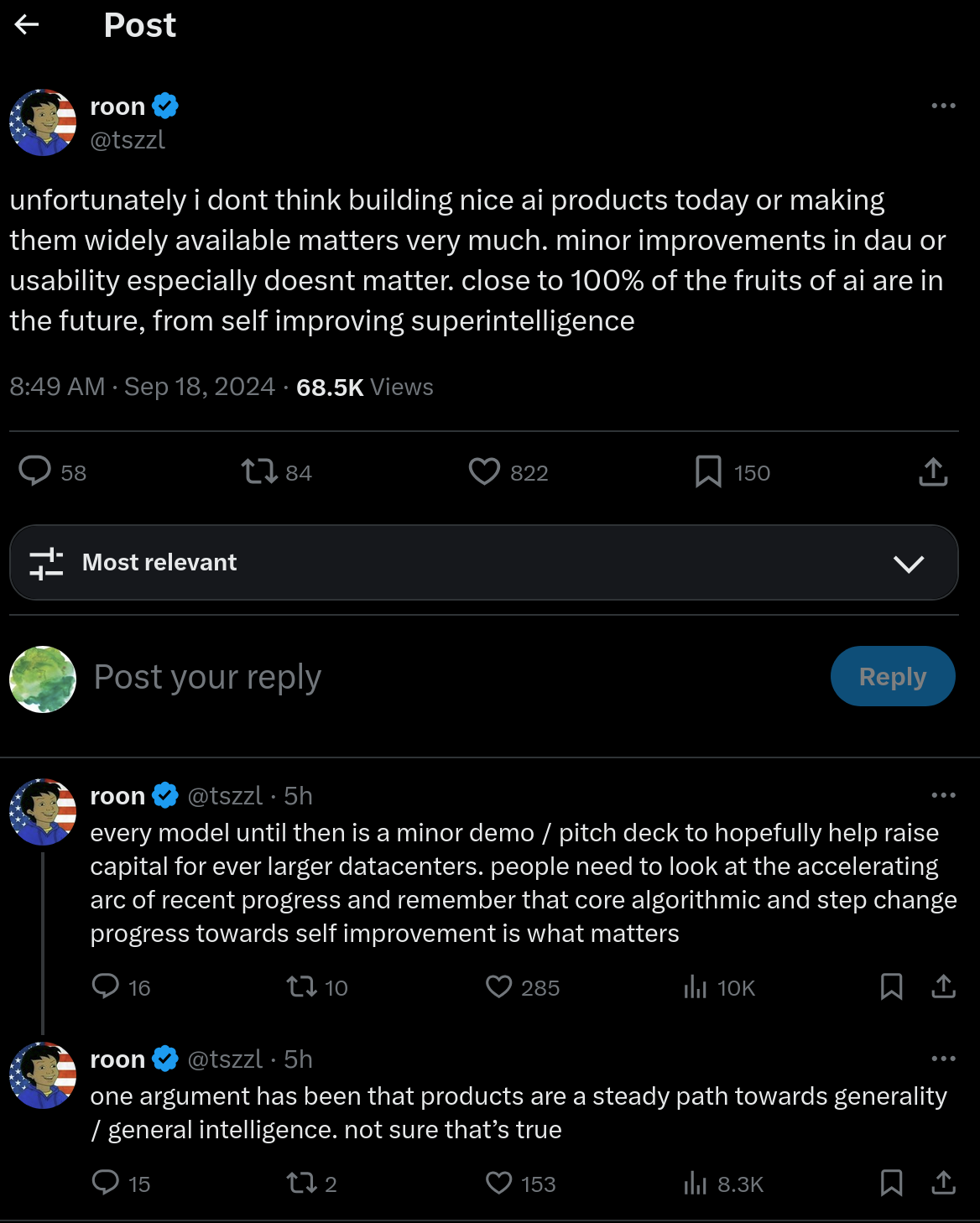
OpenAI is not building chatbots
in AIOpenAI et al. are not focused on building commercial chatbots, but on creating artificial general intelligence (AGI) or superintelligence. Their primary goal is to be the first to achieve AGI, with less concern for short-term impacts. While we debate the use of language models in education, these companies are working towards a much bigger goal.
-
Red-teaming university policy
Use AI to analyse your regulatory policies to identify how adversarial approaches could circumvent what the policy is trying to achieve.
-
Podcast: What if Dario Amodei is right?
One of the biggest challenges we face with AI is that it does the hard parts of thinking for you. It writes the first draft when you’re staring at the blank page. It reads the hard paper and summarises it for you at an easier level. It removes the challenges that you may not enjoy,…
-
Navigating AI challenges: How universities can stay relevant in the age of AI
The 2024 Work Trend Index report reveals widespread AI adoption in the workplace, posing significant challenges for universities. Higher education institutions must rapidly adapt curricula, train faculty, and emphasise AI skills to remain relevant. Failure to do so could lead to obsolescence, reduced enrollment, and competition from alternative education providers in the AI-driven job market.
-
Claude, help me condense my CV
An example of using Claude to condense a CV for a funding application.
-
Physiopedia MOOC: AI in practice, education, and research
I’ve been working with Physiopedia for a couple of months, to prepare an open online course on AI in physiotherapy, across education, practice, and research. The course includes 4 modules and 2 webinars, and is available for free.
-

Use Copilot in Edge to respond to an email in Outlook
A short post explaining how to use Copilot in Edge to respond to emails in web-based Outlook.
-
Don’t sugar coat it
A prompt to get potentially more accurate (and also more concerning) responses from ChatGPT.
-
Good (non-technical) overview of how LLMs are getting smarter
Ethan Mollick’s non-technical overview of the two scaling laws describing how generative AI models keep getting smarter.